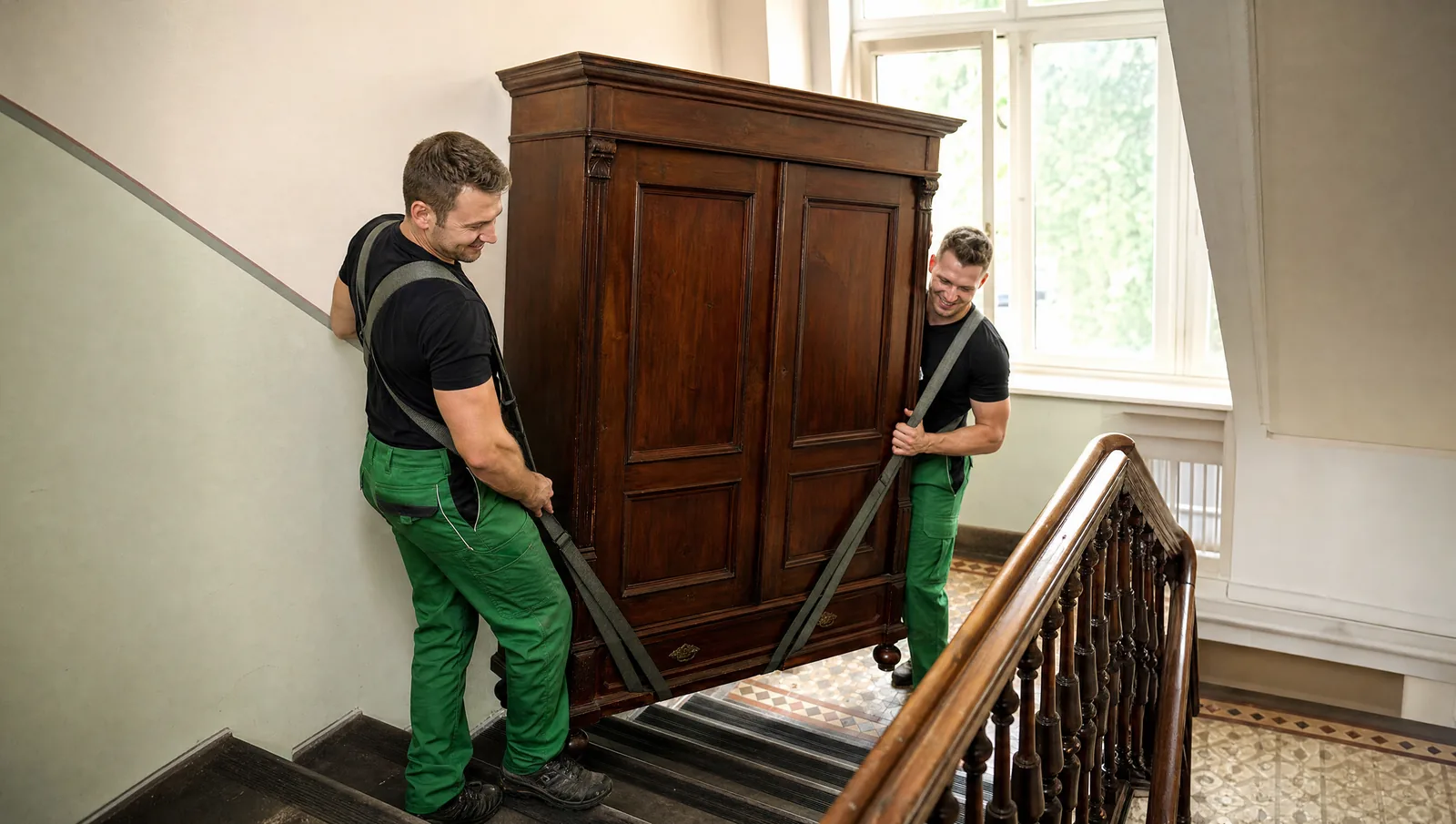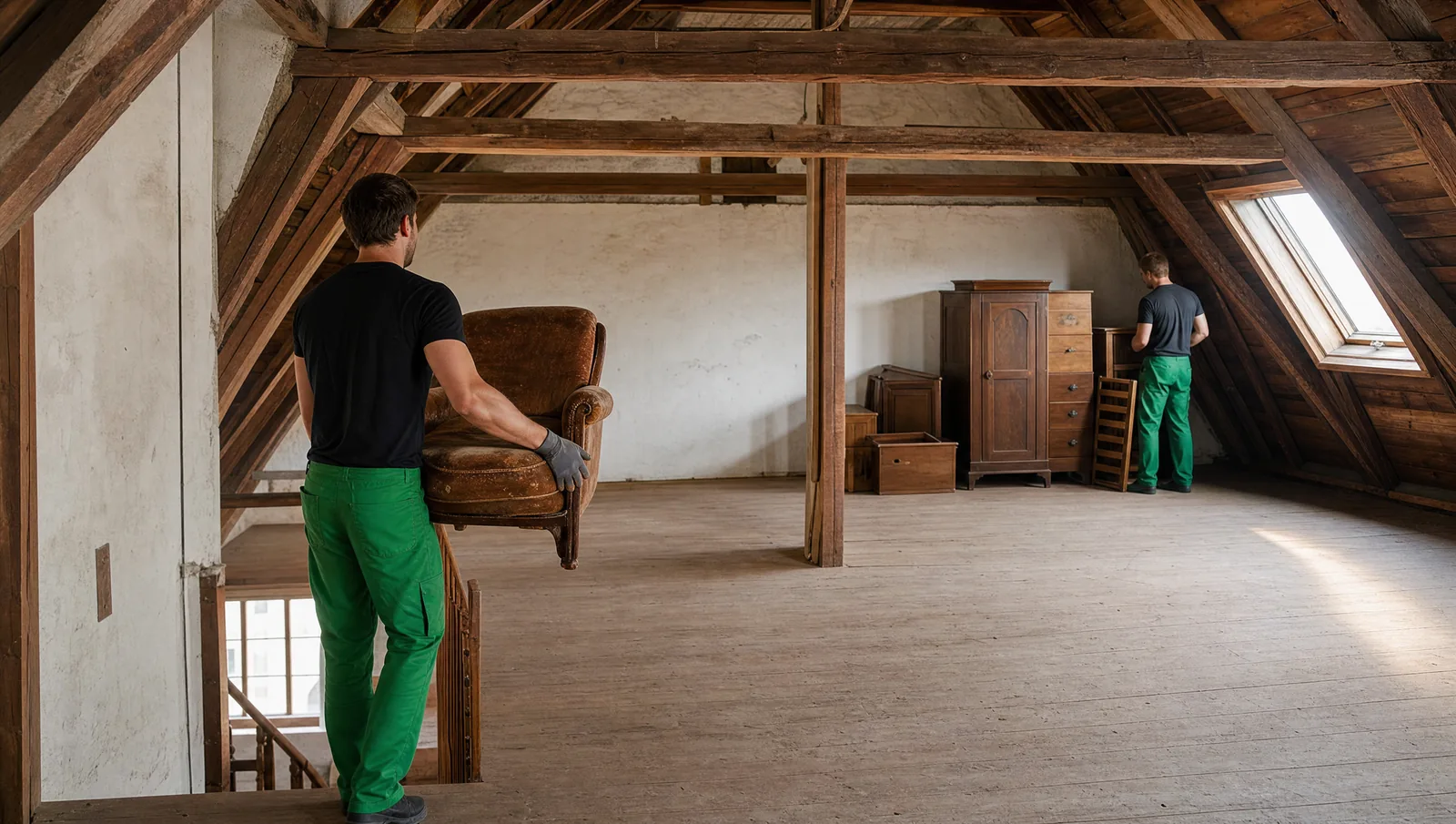
A full cellar before a move, the attic nobody has set foot in for years, or the flat of a deceased relative: a clearance is physically exhausting and sometimes emotionally draining too. With a clear plan, you keep track of everything.
This checklist takes you step by step through the preparation – from clarifying the basic conditions and sorting to the broom-clean handover.
Step 1: Clarify the basic conditions
Before the first item goes into the skip, a few questions should be answered:
- By when does everything have to be cleared? Check the notice period, handover date or date of sale.
- Who decides? In a house clearance after a death, all heirs should agree before anything is disposed of or sold. If in doubt, clarify who is entitled to inherit.
- What does the landlord require? Does the flat only need to be broom-clean, or do fixtures have to be removed?
- Access and infrastructure: Keys for the cellar and attic, electricity and lighting should work until the very end.
Step 2: Secure important and valuable items
In house clearances, things keep turning up in unexpected places. So search specifically before the actual clearing out begins:
- Documents: ID cards, contracts, insurance policies, bank statements, will, land register documents, pension notices
- Valuables: jewellery, cash, savings books, coins. Also check inside books, shoeboxes and clothing pockets.
- Keepsakes: photos, letters, family records
- Keys and login details
Tip
Set up a clearly marked “Do not dispose” box for everything that still needs to be decided on.
Step 3: Sort using the four-box principle
A simple system has proven itself: every item ends up in one of four categories. Mark the categories with coloured sticky dots if furniture doesn't fit in a box.
- Keep: Comes with you to the new home or is taken over by relatives.
- Sell: Well-preserved furniture, branded appliances, collectors' items.
- Give away or donate: Usable items that are not worth selling.
- Dispose of: Broken, worn-out, unusable items.
Work room by room and start with the area that is least emotional, often the cellar or garage. That way you get into a rhythm before tackling the living room and personal belongings.
Cellar and attic: take special care
Cellars and attics are often the most demanding areas: poor lighting, narrow stairs, dust and sometimes damp.
- Make sure there is good lighting, using site floodlights if necessary.
- Wear gloves and, where there is dust or mould, a respirator mask.
- Collect old paints, varnishes, solvents, chemicals and used oil separately; they do not belong in the general waste.
- Suspected asbestos, for example in old floor tiles, night storage heaters or fibre cement panels: do not touch it yourself but hire a specialist firm.
- Check the load-bearing capacity of attics and do not carry heavy loads over unsecured floorboards.
Step 4: Proper disposal in Darmstadt and the district
Waste disposal is regulated by the local authorities. In the city of Darmstadt, the EAD (Eigenbetrieb für kommunale Aufgaben und Dienstleistungen) is responsible; in the district of Darmstadt-Dieburg, it is the ZAW (Zweckverband Abfall- und Wertstoffeinsammlung). On their websites you will find recycling centres, opening hours and the conditions for bulky waste.
- Bulky waste (Sperrmüll): Large furniture and furnishings. Collections usually have to be booked, and limits on quantity are common.
- Old electrical appliances: Do not belong in bulky or general waste. Hand them in at the recycling centre or in shops – larger electrical retailers are obliged to take them back.
- Hazardous substances: Paints, batteries, chemicals and energy-saving bulbs via the mobile hazardous waste collection (Schadstoffmobil) or special collection points.
- Old clothes and shoes: Clothing banks or charity shops.
- Rubble and wood: Depending on quantity and type, via the recycling centre or a skip.
With large quantities, private disposal quickly reaches its limits. A professional clearance is then usually quicker and cheaper than many trips with your own trailer.
Donating and selling
Many things are too good for the bin. Charity shops, non-profit furniture exchanges or swap groups in the neighbourhood are often happy to take well-preserved furniture, household goods and books. Ask beforehand what is accepted and whether they collect. Classified ad portals and flea markets are suitable for selling. Allow enough time for this, because it often takes weeks until everything is sold.
Step 5: Broom-clean handover
“Broom-clean” (besenrein) means: the rooms are completely cleared and roughly cleaned. Coarse dirt has been removed and the floors have been swept. It does not mean a deep clean. Exactly what is required at handover is set out in the tenancy agreement.
- All rooms empty, including the cellar, attic and garage
- Floors swept, coarse dirt removed
- No leftover rubbish, cobwebs or food remains
- Meter readings taken and noted
- Handover report completed and signed
- All keys returned and receipted
Do it yourself or hire professionals?
Many people can manage smaller jobs such as a cellar room or a child's bedroom themselves without any problems. For a complete house clearance, large quantities or heavy furniture from upper floors, it is worth comparing with a professional quote. The effort and therefore the price of a clearance depend mainly on these factors:
- Quantity and type of items, i.e. the volume in cubic metres
- Accessibility: floor, lift, narrow cellar stairs, carrying distance to the vehicle
- Disposal effort: bulky waste, electrical appliances and hazardous substances are handled differently
- Items of value: well-preserved furniture or valuables may reduce the effort
- Extra services such as removing fitted units or broom-clean cleaning
A reliable quote is best drawn up after a survey. Make sure that removal and disposal are explicitly included and that the “broom-clean” service is agreed in writing.
How much time should you allow?
Don't underestimate the time involved. A complete house clearance done yourself often takes several weekends, especially when sorting and selling are added. So start as early as possible, ideally several weeks before the handover date. If you are moving at the same time, our moving checklist will help you plan.
And if time is running short or your strength is running out: we take care of clearances and house clearances in Darmstadt, Roßdorf and the region – on request together with your move or storage of the things that still need to be decided on.
Frequently asked questions
What does broom-clean mean when handing over a flat?
Broom-clean (besenrein) means the flat has been completely cleared and roughly cleaned, and the floors have been swept. It does not mean a deep clean, unless the tenancy agreement says otherwise.
What do I do with electrical appliances during a clearance?
Old electrical appliances do not belong in bulky waste. You can hand them in at the recycling centre; larger electrical retailers are obliged to take them back.
What should be clarified before a house clearance?
Clarify who is entitled to decide (in the case of an inheritance, all heirs), by when everything has to be cleared and which documents and valuables need to be secured.
Planning a move?
Get a free, no-obligation quote from Die Starken Männer in Roßdorf – for Darmstadt, the Rhine-Main area, Hesse and moves throughout Germany. Or use the moving cost calculator to get an overview first.
06071 391 80 74